You have a painful, badly damaged tooth, and your dentist gives you two choices. Save it with a root canal, or take it out and replace it with an implant.
In most cases, dentists lean toward saving your natural tooth when it still has enough healthy structure to hold a crown and a good long-term outlook.
A root canal removes the infected pulp inside the tooth, then the canals are cleaned and sealed.
Whereas an implant is the better plan when the tooth is cracked below the gumline, too decayed to rebuild, or has already failed more than once.
So how does your dentist actually make that call? The decision comes down to a few clear things: the condition of your tooth, the health of your bone and gums, your budget, and how much time you can give to treatment.
Understanding the key differences between the two options helps you ask better questions and feel confident about the plan for your oral health.
Key Takeaways
- Your dentist first checks whether enough healthy tooth structure remains to support a crown.
- A root canal keeps your natural tooth, while an implant replaces one that cannot be repaired.
- Cost, healing time, and long-term risks all differ, so ask for a full estimate of each path.
The First Decision: Can the Natural Tooth Be Restored?
Before your dentist talks about implants, they look closely at how much healthy tooth you still have and whether it can hold a crown or filling long term.
That answer depends on the tooth structure above and below the gumline, the condition of the root, and how well your gums and jawbone are supporting everything.
What Makes a Tooth a Good Candidate for Root Canal Treatment
Root canal treatment works best when the outside of the tooth is still solid, even if the inside is inflamed or infected.
During the procedure, your dentist or endodontist removes the infected pulp and seals the tooth, then protects it with a crown so you can chew normally again.
Good signs for saving the tooth include:
- Enough tooth structure left to support a crown, ideally with solid walls above the gumline
- An intact root with no deep split or fracture
- Healthy gums and steady bone holding the tooth in place
- A single, treatable infection rather than repeated failures at the same tooth
Even a tooth with deep decay can often be saved. As one clinical guide notes, a bad cavity does not automatically mean extraction if the damage stays in a repairable spot.
Signs a Tooth May Be Beyond Repair
Some problems are simply hard to fix in a lasting way. A vertical root fracture that runs down through the root is one of the clearest examples, because there is no reliable way to bond a split root back together.
Watch for these red flags:
| Warning Sign | Why It Matters |
| Crack extending below the gumline | Bacteria keep getting in, so the seal fails |
| Very little tooth left above the gum | Nothing solid to anchor a crown |
| Advanced gum disease with bone loss | The tooth stays loose even after treatment |
| Repeated retreatment that keeps failing | Each round removes more structure |
Pain when you bite and release, swelling, drainage, or a tooth that feels loose without any injury are all reasons to get checked quickly.
Keep in mind that symptoms don’t always match severity, a tooth can feel mild while the root or bone underneath is in trouble.
Why Saving a Natural Tooth Is Usually Considered First
Your natural tooth is hard to beat. It sits in the jawbone with its own ligament, which helps you sense pressure while chewing and keeps the surrounding bone stimulated.
Keeping it also protects your neighboring teeth. There’s no need to reshape nearby teeth or wait through healing and grafting stages, and root canal treatment with a crown usually costs less upfront than extraction plus an implant.
That said, “save it first” isn’t a rule without limits.
When a damaged tooth has a poor long-term outlook, replacing it can be the more predictable path, and your dentist should walk you through both options honestly before you decide.
How Root Canal Treatment Saves a Tooth
A root canal clears out infected pulp, disinfects the canal system, and seals the inside of your tooth so bacteria can’t return. Add a crown on top, and that tooth can keep chewing for years.
What Happens During the Root Canal Procedure
Your dentist starts with local anesthetic, so the area goes numb before anything begins.
Next comes a small opening in the top or back of the tooth. Through that opening, your dentist removes the inflamed or infected pulp, which includes the nerves, blood vessels, and connective tissue inside the tooth.
Then the canals get shaped, cleaned, and rinsed. Once they’re dry, they are filled with a rubber-like material called gutta-percha and sealed to block reinfection.
Most single-root teeth wrap up in one visit. Molars have more canals, so they sometimes take two.
You may feel tender for a few days afterward. That usually settles down with ibuprofen or acetaminophen.
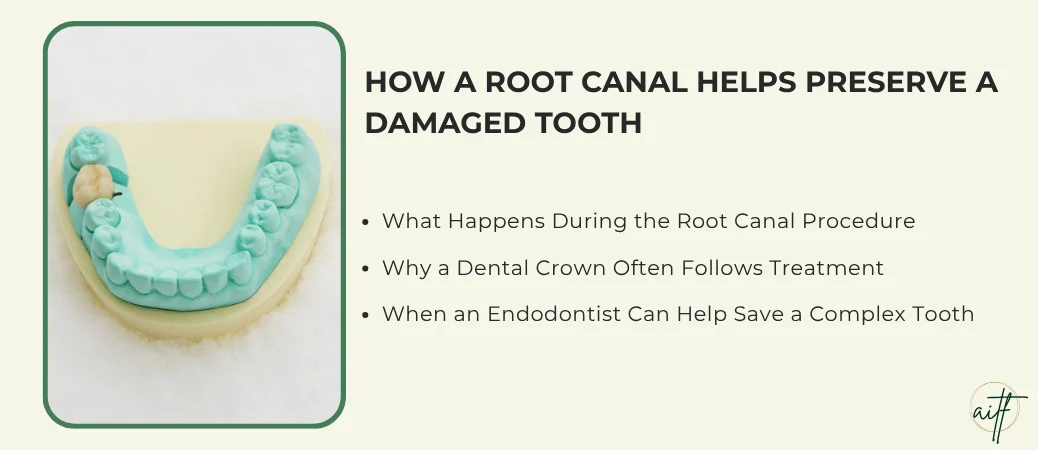
Why a Dental Crown Often Follows Treatment
A treated tooth is clean on the inside, but it’s also hollow and more brittle than before.
That’s why a root canal and crown usually go together, especially on molars and premolars that grind food.
The crown caps the tooth, spreads out chewing pressure, and keeps it from cracking.
Here’s the typical order:
| Step | What it does |
| Core filling | Fills the access opening and supports the crown |
| Post (if needed) | Adds anchoring when little tooth structure remains |
| Crown | Covers and protects the whole tooth |
Front teeth take less force, so a filling is sometimes enough.
Skipping the crown is the most common reason a treated back tooth fails later. Restoring it promptly is a big part of long-term success, along with regular brushing, flossing, and checkups.
When an Endodontist Can Help Save a Complex Tooth
An endodontist is a dentist with two or three extra years of training focused on the inside of teeth.
They handle the tricky cases: curved or calcified canals, molars with extra canals, retreatment of a root canal that didn’t heal, and teeth with cracks or past trauma.
Their tools help, too. Surgical microscopes and 3D cone beam scans let them find canals that are hard to see on a regular X-ray.
Comparing Time, Cost, Recovery, and Long-Term Risks
The price tag is only part of the picture, how many visits you need, how long healing takes, and what could go wrong years later all matter too.
Here’s how the two paths stack up on money, time, and lasting results.
Root Canal Cost and Dental Insurance Coverage
A root canal usually costs less up front than removing the tooth and replacing it. In the U.S., you can expect roughly $700–$1,200 for a front tooth and $1,000–$1,800 for a molar, since molars have more canals to clean and seal.
Most teeth also need a crown afterward, which adds about $1,000–$2,000.
Dental insurance benefits for root canal treatment vary by plan. A dental provider can help patients understand their benefits and file claims on their behalf.
Because saving the tooth is typically less invasive and less expensive than pulling and replacing it, this route often means fewer appointments and a smaller bill.
Dental implant coverage varies by insurance plan. Ask for a treatment estimate so you can understand your expected costs and available payment options.
Dental Implant Cost and Additional Treatment Needs
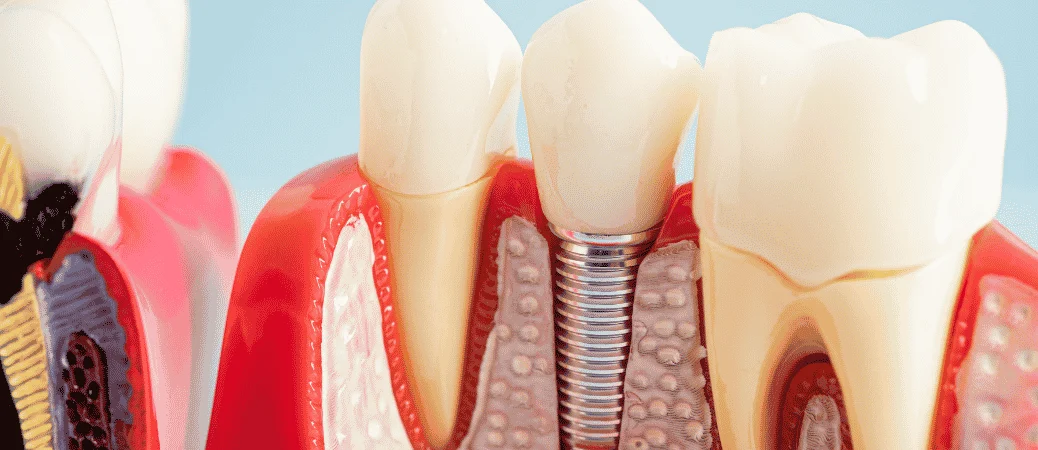
Implants cost more because you’re paying for several separate steps. A single implant usually runs $3,000–$6,000+ once you add up the extraction, the titanium post, the abutment, and the crown.
Extra work can push that higher:
| Add-on treatment | Typical cost |
| Tooth extraction | $200–$600 |
| Bone graft | $400–$1,200 |
| Sinus lift (upper molars) | $1,500–$3,000 |
Dental implant benefits vary by insurance plan, so ask for a treatment estimate before moving forward.
Recovery Time, Success, and Maintenance Expectations
Recovery is where the timelines really split apart.
After a root canal, you’ll likely feel tender for 2–4 days and can go back to work the next day. An implant needs surgery, then 3–6 months of bone healing before the final crown goes on.
Both options work well long term. Research comparing root canal therapy and dental implants found high survival rates for each, though treated teeth may need retreatment or a new crown down the road.
Implant failure is less common but harder to fix. The main threat is peri-implantitis, an infection of the gum and bone around the post.
Your habits move the needle a lot. Daily brushing and flossing, regular cleanings, quitting smoking, and keeping diabetes under control all improve your odds, smoking and uncontrolled diabetes raise the risk of implant problems in particular.
Options When a Previous Root Canal Has Failed
A tooth that hurts years after treatment isn’t automatically headed for the trash bin.
Depending on what went wrong, you may have three paths: clean and reseal the canals, treat the root tip with a small surgery, or remove the tooth and replace it.
When Root Canal Retreatment May Work
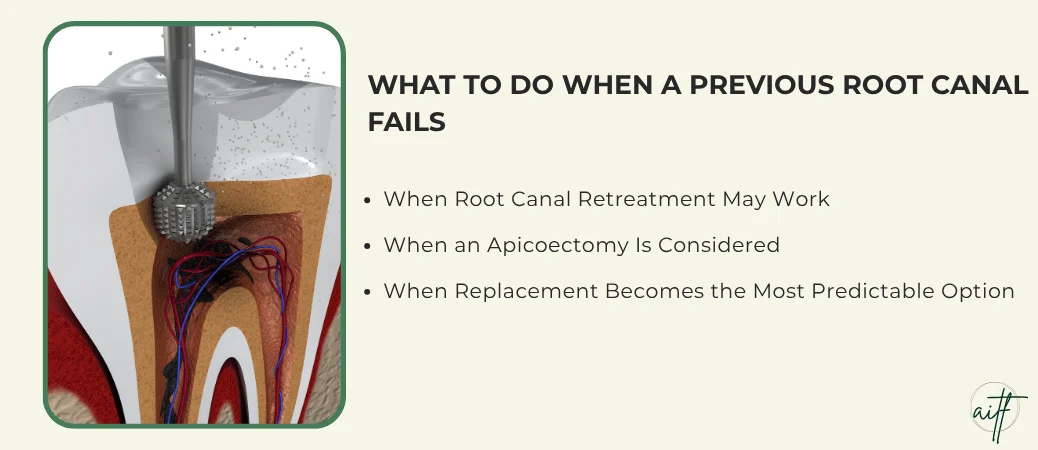
Retreatment is usually the first thing to consider. Your dentist removes the crown or filling, takes out the old root filling material, and cleans and disinfects the canals again before sealing the tooth.
This works best when the problem is reinfection, a missed canal, a leaky crown, a new cavity, or a crack in the filling seal.
The tooth still needs enough solid structure left to hold a crown. If it does, removing the old filling material and resealing often beats replacing it.
When an Apicoectomy Is Considered
Sometimes the canals were treated well, but infection stays near the root tip. An apicoectomy is a small surgery where the endodontist opens the gum, removes the last few millimeters of the root, and seals the end.
Your dentist may suggest it when:
- Retreatment already failed, or the canals can’t be reopened safely
- A post and core or strong crown would be damaged by going back in through the top
- There’s a cyst or stubborn lesion at the root tip
- A canal is blocked, curved, or calcified
Recovery usually takes a few days of mild swelling and soreness. It’s a targeted fix, so it works best when the rest of the tooth and the gum support around it are healthy.
This is the second chance many treated teeth get before anyone talks about pulling it.
When Replacement Becomes the Most Predictable Option
Some teeth can’t be rescued. Extraction is the most drastic step, so it’s reserved for teeth that are structurally or periodontally beyond repair.
Warning signs point that way:
| Finding | Why it changes the plan |
| Vertical root fracture | Can’t be sealed; bacteria keep getting in |
| Deep decay below the gum | Not enough tooth left for a crown |
| Advanced bone loss | The tooth is loose even if the canal heals |
| Root perforation or resorption | Seal and support are lost |
When it isn’t, a dental implant is often the most predictable replacement.
Just know that implants aren’t risk-free either, implant failure happens, and it’s worth weighing success rates, costs, and timelines side by side before you decide.
Getting a Clear Recommendation for Your Specific Tooth
No two damaged teeth are the same, so the right answer for your neighbor’s molar may not be the right answer for yours.
A thorough dental exam, a few direct questions, and sometimes a second look from another dentist can give you real clarity.

What a Complete Dental Evaluation Should Assess
A useful dental evaluation mixes what your dentist sees, what they feel with instruments, and what shows up on images.
Here’s what should be checked before anyone talks about pulling the tooth:
| What’s checked | Why it matters |
| Remaining tooth structure | A tooth needs enough solid wall left to hold a crown |
| Cracks and vertical fractures | A crack running down the root usually rules out saving it |
| Bone around the root | Bone loss from infection or gum disease affects long-term odds |
| Root shape and canal anatomy | Curved or blocked canals make treatment harder |
| Jawbone height and width | Thin or short jawbone may need grafting before an implant |
| Bite forces and habits | Grinding puts extra stress on both options |
X-rays help, but a 3D cone beam scan shows details a flat image can miss. Ask if one makes sense for your case.
Questions to Ask Before Choosing Treatment
You’re allowed to ask plenty of questions. Good ones include:
- What are the odds this tooth lasts five or ten years if we do the root canal?
- Will I need a crown, and is that price included in what you quoted me?
- If the root canal fails, what happens next, and what will that cost?
- Do I have enough bone for an implant, or would I need a graft first?
- How many appointments and months are we talking about for each path?
Ask for the total cost of each plan, not just the first step.
Why a Second Opinion May Be Valuable
If the plan involves removing a tooth you’d rather keep, a second opinion is reasonable. Specialists look at these cases from different angles.
An experienced dentist focuses on saving teeth and treats tricky canals daily. Your dentist can tell you honestly whether your bone and gums can support an implant.
Seeing both gives you a fuller picture of the root canal vs. implant choice. Many general dentists refer you out for this exact reason.
Bring your recent X-rays so you don’t pay for new ones. Then compare what you hear.
Saving a natural tooth is usually preferred when the odds look good, because it keeps your bite and bone intact.
Still, your own comfort with the timeline, cost, and oral health goals belongs in the decision too.
Frequently Asked Questions
Dentists look at how much healthy tooth is left, whether the root and surrounding bone are solid, and how well the tooth can hold a crown.
Below are answers to the questions patients ask most when choosing between saving a tooth and replacing it.
How do dentists decide whether a tooth can be saved with a root canal?
Your dentist checks the tooth with X-rays, sometimes a 3D scan, and a hands-on exam. They want to know how deep the decay or crack goes, and whether enough solid tooth sits above the gum line to hold a crown.
They also look at the bone around the root and how the tooth lines up with your bite. When the tooth can be cleaned out and rebuilt, saving it is usually the recommendation because your natural tooth root keeps the jawbone stimulated.
When is a dental implant a better choice than a root canal?
A dental implant makes sense when the tooth is beyond repair or has already fallen out. A vertical crack that runs into the root, severe bone loss from gum disease, or a root that has fractured are common reasons.
Before suggesting an implant, your dentist checks that you have enough bone support and good general health to heal well.
Implants can fail in people with uncontrolled diabetes or heavy smoking habits, so those factors matter too.
What factors make a tooth too damaged to restore?
A few situations usually rule out a root canal:
- A crack that extends below the gum into the root. These teeth leak bacteria and cannot be sealed.
- Not enough tooth left above the gum. A crown needs a solid rim of tooth to grip.
- Advanced gum disease. If the bone that holds the root is mostly gone, the tooth stays loose.
- A root that is fractured or badly resorbed.
- Repeated failed treatment. Some teeth get retreated once and still keep flaring up.
The amount of healthy tooth structure left, plus the condition of the surrounding bone, drives most of these calls, especially on back molars that take heavy chewing force.
How long does a root canal-treated tooth usually last compared with an implant?
Both can last a very long time when you care for them. A treated tooth may last a lifetime, though some need retreatment or a fresh crown after 10 to 20 years.
The titanium implant post also tends to last for decades. The crown attached to it often needs replacing every 10 to 15 years from normal wear.
Daily brushing, flossing, and regular checkups affect the outcome more than the type of treatment.
Is it more painful to get a root canal or have a tooth removed and replaced with an implant?
Both start with numbing, so you should not feel sharp pain during the visit. Most people describe a root canal as similar to getting a large filling, with mild soreness for a couple of days after.
Getting an implant involves more steps. First the tooth comes out, then the implant goes in, and healing takes several months before the crown is placed.
That adds up to more total recovery time and usually more discomfort along the way.
What are the costs and recovery times for a root canal versus an implant?
A root canal plus a crown generally costs less than an implant. Prices shift based on which tooth is involved and whether you see a specialist.
Recovery is quicker too. You can usually eat normally within a day or two after a root canal, and the crown often goes on a few weeks later.
Implants take patience. The bone needs roughly three to six months to fuse with the post, and a bone graft adds even more time.