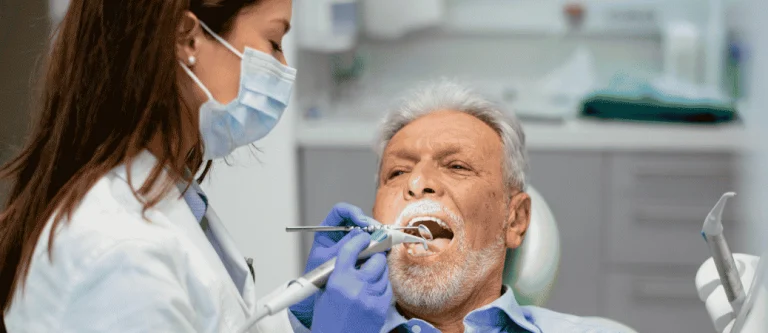
When you choose All-on-4 dental implants, you expect a strong bite and a natural smile. You may also wonder how your speech will change. That concern makes sense because your teeth, tongue, and lips all work together when you talk.
Most patients report mild and temporary speech changes after All-on-4 implants, and they adjust within a few weeks with practice and small dental tweaks if needed.
Right after surgery, you may notice a lisp, a slight whistle, or trouble with “S,” “F,” or “V” sounds. Many people improve by speaking out loud each day and giving their mouths time to adapt.
In some cases, your dentist adjusts the shape or thickness of the prosthesis to improve sound clarity. Patients who learn about speech changes ahead of time often feel more confident during recovery.
When you know what to expect from all on 4 implants speech, you stay patient and focus on steady progress.
Key Takeaways
- You may notice short-term speech changes after All-on-4 dental implants.
- Most issues improve with daily speaking practice and minor adjustments.
- Clear guidance and follow-up care support strong speech results.
Table of Content
- How All-on-4 Dental Implants Influence Speech
- Common Speech Issues and Their Underlying Causes
- Factors Affecting Speech Outcomes
- Managing and Improving Speech After All-on-4
- Clinical Insights and Patient Quality of Life
- Frequently Asked Questions
How All-on-4 Dental Implants Influence Speech
All-on-4 dental implants can change how your tongue, teeth, and lips work together when you speak. Most changes are temporary, but some sounds may need practice to feel natural again.
Initial Speech Adjustments After Implant Placement
Right after implant placement and delivery of your prosthetic restoration, your mouth feels different. The shape and thickness of the new teeth and base can affect how air moves when you talk.
You may notice changes with sounds like “s,” “z,” “t,” and “d.” These sounds depend on precise tongue contact with the front teeth and the ridge behind them.
If the new teeth sit slightly differently than your natural teeth or denture, your tongue must relearn its position.
Some patients report a mild lisp or slight slurring during the first few weeks.
Clinical findings on the impact of fixed implant prosthetics using the all-on-four treatment concept on speech intelligibility show that consonant distortions are common in the early months, especially with “s” and “z” sounds.
These changes do not mean the dental implants failed. They reflect normal adjustment to a new tooth position and bite.
Why Full-Arch Prosthetics Affect Pronunciation
When you replace a full arch due to edentulism, you change more than just your smile. Teeth guide airflow and give your tongue a surface to press against during speech.
With all-on-4 dental implants, the prosthetic restoration connects to four implants and spans the arch. To ensure strength and support, the framework and acrylic or ceramic teeth may add slight bulk compared to natural teeth.
This added thickness can:
- Shift where your tongue touches during speech
- Change airflow for sharp consonants
- Alter how your lips meet the teeth
Research and clinical reports note that prosthetic design must balance strength and speech clarity. Even small design changes can affect pronunciation.
Your dentist adjusts tooth position and contour during planning, but minor speech differences can still occur.
Adaptation and Timeline for Speech Improvement
Most people adapt to their new teeth within days to a few weeks. Your brain and tongue quickly learn the updated shape of your mouth.
Many patients experience only short-term speech changes. In many cases, speech improves as you practice normal conversation.
You can speed up adaptation by:
- Reading out loud for 10–15 minutes a day
- Practicing difficult sounds like “s” and “sh”
- Speaking slowly and clearly at first
If speech concerns last beyond a few months, your dentist can evaluate the prosthetic restoration. Small adjustments to contour or bite may improve clarity.
With time and minor fine-tuning, most patients speak clearly and comfortably with their All-on-4 dental implants.
Common Speech Issues and Their Underlying Causes
Many speech changes after All-on-4 treatment relate to how your tongue, teeth, lips, and airflow interact with the new prosthetic restoration.
Small shifts in tooth position, arch width, or vertical dimension of occlusion can change how certain sounds form.
Sibilant and Labiodental Sound Difficulties (‘S’, ‘Z’, ‘F’, ‘V’)
You may notice a lisp, slur, or faint whistle when you say “S” or “Z.” These sounds require light contact between your upper and lower front teeth and controlled airflow.
If the front teeth sit too far forward or too long, they can create too much contact. That often leads to a lisp. If a small gap forms under the bridge during healing, air may escape and cause a whistle.
Some dentists describe this as a common issue with All-on-4 speech problems.
“F” and “V” sounds depend on your upper teeth touching your lower lip. If your teeth sit too high or too low in the prosthetic design, these sounds can feel awkward. Even a small change in length can affect clarity.
Your dentist may adjust tooth length or refine the fit of the prosthetic restoration to improve airflow and contact.
Linguodental and Bilabial Sound Challenges (‘TH’, ‘L’, ‘B’, ‘M’, ‘P’)
“TH” and “L” sounds depend on precise tongue placement. Your tongue must contact the back of your front teeth or pass lightly between them.
If the teeth in your all on 4 restoration sit too far inward or outward, your tongue may struggle to find its normal position. This can make speech feel forced or unclear. Limited space between your upper and lower teeth can also restrict tongue movement.
“B,” “M,” and “P” sounds require your lips to press together. If your bite feels too open, your lips may not meet easily. You might feel like your face looks longer or that you cannot close your lips in a natural way.
These changes are common in patients who previously had edentulism. Your mouth adapted to missing teeth, and now it must adjust again to fixed teeth.
Impact of Prosthetic Design and Bulk
The shape and thickness of your prosthetic design directly affect speech. Full-arch implant bridges can feel bulky, especially behind the front teeth.
If the bridge covers areas where your tongue once touched during speech, certain sounds may change. Dentists note that speech difficulties are common during the restorative phase of full-arch hybrids, especially when bulk affects phonetics.
Arch width also matters. If your new teeth narrow the space your tongue once used, you may slur “SH” or “S” sounds. If both arches receive treatment, your dentist can adjust width more easily.
If only one arch changes, options may be limited.
Careful planning of implant position and final prosthetic restoration helps reduce these problems.
Role of Vertical Dimension of Occlusion in Phonetics
Your vertical dimension of occlusion (VDO) is the space between your upper and lower jaws when your teeth touch. This measurement plays a key role in speech.
If your VDO increases too much, your lips may struggle to close. This affects “B,” “M,” and “P” sounds. If it decreases too much, your lower face may feel compressed, which can change how air moves during “S” and “Z” sounds.
You also need enough freeway space, which is the small gap between your teeth when your jaw rests. Limited space can restrict tongue motion during “TH” and “L.”
Your dentist may adjust tooth height or remake a provisional bridge to refine VDO. These changes often improve clarity as your muscles adapt to the new bite.
Factors Affecting Speech Outcomes
Your speech after All-on-4 treatment depends on how your implants are placed, how the prosthetic restoration is designed, and how your mouth adapts over time. Small changes in shape, thickness, or bite height can change how air moves and how your tongue contacts your teeth.

Positioning and Angulation of Dental Implants
Implant placement plays a direct role in how clearly you speak. Your surgeon places four dental implants at specific angles to support a full-arch prosthetic restoration.
If the anterior teeth sit too far forward or too high, you may struggle with sounds like “s,” “z,” “t,” and “d.”
A study on the impact of fixed implant prosthetics using the all-on-four treatment concept on speech found that many patients showed consonant distortions months after placement.
Air may also escape between your prosthesis and gum tissue if spacing is not ideal. This can create a slight lisp or whistling sound.
Precise angulation, correct tooth position, and stable osseointegration all support better speech. When your implants anchor firmly and your prosthetic design matches your jaw shape, your tongue can form sounds more naturally.
Prosthesis Thickness and Material Choice
The thickness and contour of your prosthesis affect how your tongue moves. If the prosthesis feels bulky behind your front teeth, your tongue may not have enough room to shape airflow.
Full-arch restorations must balance strength and comfort. Also, excess acrylic or framework bulk can strain phonetics.
Material choice also matters. Acrylic, zirconia, and metal frameworks differ in thickness and weight. A thicker design may improve strength but limit tongue space.
Your dentist also sets your vertical dimension of occlusion, or bite height. If this height changes too much, your lips and tongue must relearn how to meet your teeth. Even small changes can affect clarity.
Careful prosthetic design reduces these risks and supports smoother speech.
Occlusal Wear and Adaptation Over Time
Your speech often improves as you adapt. Many patients report mild and temporary changes, especially early on.
Your brain and muscles adjust to the new tooth shape and surface. You learn how to control airflow against the prosthetic restoration.
Over time, occlusal wear may slightly change how your teeth meet. Minor adjustments by your dentist can fine-tune your bite and improve sound clarity.
If distortions continue after healing and full osseointegration, your dentist may adjust tooth position or contour. In some cases, speech therapy focused on tongue placement can also help retrain sound production.
Managing and Improving Speech After All-on-4
You can improve speech after All-on-4 with daily practice, small dental adjustments, and steady follow-up care. Most changes fade as your tongue and lips adapt to the new prosthetic restoration.

Speech Exercises and Practice Techniques
You need to retrain your tongue to move around your new teeth. Many patients notice changes in “s,” “sh,” “f,” and “v” sounds during the first few weeks. This happens because airflow and tongue placement shift with the new bridge.
Start with slow reading practice for 10–15 minutes a day. Read out loud from a book or news article. Focus on clear “s” and “th” sounds.
You can also try:
- Repeating tongue twisters that stress “s” and “t”
- Counting from 60 to 79 to practice “s” blends
- Recording your voice to track progress
An adjustment period is normal. If speech feels very strained, ask your dentist whether a speech therapist could help with guided tongue and airflow exercises.
Dental Adjustments and When to Seek Help
Your prosthetic restoration must fit with the right thickness and contour. If it feels bulky or affects certain sounds even after practice, your dentist may need to reshape small areas.
Minor changes to the bridge can improve clarity. Small adjustments can make a big difference in speech comfort once healing is complete.
Contact your dentist if you notice:
- Ongoing lisping after several months
- Clicking sounds when you speak
- Pain or pressure under the bridge
- Signs of gum problems, such as swelling or bleeding on probing
Speech problems that last beyond the early healing phase may point to bite imbalance or prosthetic design issues. Do not ignore these signs.
Long-Term Follow-Up and Maintenance
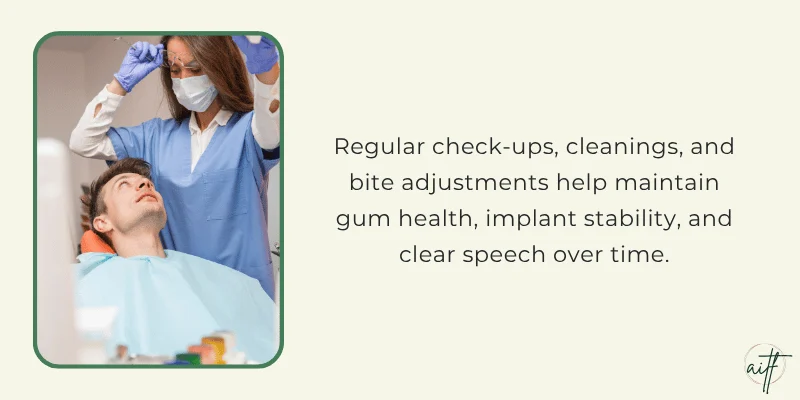
You protect your speech by keeping up with long-term follow-up visits. Your dentist checks bite balance, signs of dental implant failure, and gum health at each appointment.
During these visits, the team may test for bleeding on probing to monitor tissue health around the implants. Healthy gums support stable speech because inflammation can change how your bridge sits.
Professional cleanings remove plaque under the prosthetic restoration. At home, use special floss or water irrigation tools designed for all-on-4.
Regular reviews allow your dentist to adjust the prosthesis if wear changes your bite over time. Steady maintenance keeps your speech clear and your implants secure.
Clinical Insights and Patient Quality of Life
Clinical studies and patient reports show how all-on-4 dental implants affect your speech, comfort, and daily life.
Evidence from long-term follow-up also explains how osseointegration and full-arch stability support both function and confidence after edentulism.
Research Findings on Speech and All-on-4
Researchers have tracked patients with all-on-4 dental implants for many years. Data from long-term clinical success of the All-on-4 treatment concept show stable results for full-arch restorations, including cases followed for up to 18 years.
Speech changes often happen in the first weeks after surgery. Your tongue must adjust to the new prosthetic teeth and the shape of the arch. Most patients report mild difficulty with certain sounds, such as “s” or “f,” during early healing.
As osseointegration completes and swelling goes down, speech clarity usually improves. Regular checkups help your dentist adjust the prosthesis if airflow or tongue space affects pronunciation.
Clinical reviews stress the need to evaluate more than implant survival. Biological and prosthetic outcomes both matter when you measure real treatment success, including comfort and function.
Impact on Social Reintegration and Confidence
If you lived with edentulism or loose dentures, you may have avoided speaking in public. Many patients say they felt anxious about slurred speech or denture movement before treatment.
Studies on oral health-related quality of life in implant patients show that fixed implant prostheses improve daily comfort and social interaction. When your teeth feel stable, you tend to speak more freely.
Patients often report:
- Less fear of teeth shifting while talking
- Better ability to chew and speak at the same time
- More comfort during long conversations
You may still need a short adjustment period. However, once your speech feels natural again, many people return to work, family events, and social settings with more ease.
Oral Health Outcomes After All-on-4 Treatment

All-on-4 dental implants anchor a fixed bridge using four implants per arch. After osseointegration, the implants bond with your jawbone and create a stable base for speech and chewing.
Research on oral health-related quality of life and satisfaction in edentulous patients treated with the All-on-Four concept links this approach to higher satisfaction levels. Patients often report improved comfort compared to removable dentures.
Your long-term outcome depends on:
- Proper oral hygiene
- Regular dental visits
- Monitoring of gum and bone health
With consistent care and long-term follow-up, you can maintain clear speech, stable function, and healthy tissues around your implants.
Frequently Asked Questions
Many patients notice small speech changes after All-on-4 surgery, especially with certain sounds like “S” or “F.” Most issues improve with healing, simple practice, and small dental adjustments when needed.
Will my speech sound different right after surgery, and how long does it take to adjust?
Yes, your speech may sound different in the first few days or weeks.
Swelling, numbness, and the added bulk of a temporary bridge can change how your tongue and lips move. You may feel like your mouth is “full” at first.
Most people adjust within a few weeks. Some dentists recommend giving yourself up to eight weeks before making major changes, since your tongue needs time to learn the new shape of your teeth.
Why do some people notice a lisp after getting full-arch implants, and what helps it improve?
A lisp often affects “S,” “SH,” or “Z” sounds.
These sounds depend on light contact between your upper and lower front teeth and steady airflow. If your front teeth sit slightly too long, too short, or too far forward, air can escape in the wrong way.
Healing can also create small gaps between the bridge and your gum tissue. This may cause a whistling sound until your dentist relines or seals the area.
If the lisp lasts beyond the early healing period, your dentist may adjust the tooth length or fine-tune the bridge.
Are there specific sounds or words that are hardest to pronounce during the first few weeks?
Yes. Patients most often report trouble with:
- “S,” “SH,” and “Z” (like “sixty-six”)
- “F” and “V” (like “fifty-five”)
- “TH” (like “thirty-three”)
“S” sounds can feel sharp or airy at first. “F” and “V” depend on your upper teeth touching your lower lip at the right spot.
Your tongue also needs enough room behind your front teeth to form clear “T,” “D,” and “N” sounds. If the bridge feels bulky behind the front teeth, these sounds may feel awkward early on.
What can I do at home to practice speaking clearly after getting my new teeth?
Read out loud for 10 to 15 minutes a day.
Repeat word pairs that focus on problem sounds, such as “sip” and “ship,” or “fan” and “van.” Short number phrases like “sixty-six” and “fifty-five” also help you check tooth position and airflow.
Speak slowly at first. Clear speech improves when you slow down and let your tongue find the right contact points.
How can I tell if my new teeth are affecting my bite or tongue space enough to change my speech?
Pay attention to how your teeth meet when you say “S” sounds.
Your front teeth should come very close together without heavy pressure. If they hit too hard or do not come close at all, your bite may need adjustment.
Notice how your tongue feels at rest. If it feels crowded or pushed back, the arch width or thickness of the bridge may limit tongue space.
You may also struggle to bring your lips together for “B,” “M,” or “P” sounds if your bite feels too open. Tell your dentist if these problems continue past the first several weeks.
What are the warning signs that something is wrong with my implants if my speech suddenly worsens?
Sudden changes after you were already speaking well deserve attention.
Watch for:
- A new loose feeling in the bridge
- Clicking sounds when you chew
- Pain, swelling, or gum irritation
- A gap you can feel between the bridge and your gums
A small change in fit can affect airflow and speech. Contact your dentist if your speech worsens quickly instead of slowly improving.