A trial smile before veneers gives you a real look at the shape, length, and feel of a proposed design before anything permanent happens.
It can reliably show whether the shape, apparent length, and proportions of new teeth suit your face and how they feel when you talk, but it cannot promise the final color, translucency, bite comfort, longevity, or whether your teeth are healthy enough for veneers.
That gap matters because veneers are elective and, in most cases, permanent. A preview made of temporary resin is a simulation of the design. It is a useful one, but it is still a rehearsal.
If you know which parts of the preview to trust, you can give your dentist clearer feedback and walk into the decision with fewer surprises.
Key Takeaways
- Use the preview to judge shape, length, speech, and how the design fits your face.
- Expect the final porcelain color, texture, and bite to differ from the temporary version.
- Ask for changes during the trial, when edits are fast and free of tooth changes.
What Can You Judge While Wearing a Trial Smile?
A trial smile is strongest at showing the “architecture” of your new teeth: their outline, how far they reach, and how they sit with your lips.
You can check how the design frames your face, how the new edges feel against your lip and tongue, and whether the change still looks like you in a mirror and on camera.
Do the Shape and Length Suit Your Face?
This is where a preview earns its keep. Smile design choices like square versus rounded corners, or a slightly longer pair of front teeth, look subtle on a model. On your own face, they jump out.
Stand back from the mirror. Look at your smile at rest, mid-sentence, and in a full laugh. Ask yourself:
- Do the front teeth follow the curve of your lower lip when you smile?
- Do the teeth show too much or too little when your lips are relaxed?
- Do the corners look soft and natural or sharp and blocky?
- Does the width look balanced from the side, or only straight on?
Take photos in daylight and indoor light. A quick look in the dental chair mirror tends to be kinder than a phone camera by a window, and both views help.
How Do the New Edges Feel When You Speak and Smile?
The incisal edges (the biting edges of your front teeth) touch your lower lip on “F” and “V” sounds. Air also passes between your teeth on “S” sounds. If those edges move, your speech can feel different for a while.
Read a paragraph out loud. Count from 60 to 70. Say “Mississippi” and “five fluffy feathers.” Notice any whistle, lisp, or spots where your lip catches.
Most people adjust to small changes within days. If a sound feels badly off in the first few minutes, tell your dentist right then, because edge length is easy to tweak on the mock-up.
Does the Overall Change Feel Like You?
A bespoke smile should look like an upgraded version of your own face. This part is personal, and no software can grade it for you.
Some people love a bold smile transformation. Others realize in the mirror that they wanted something quieter. Both reactions are useful.
If you can wear the preview for a while, share photos with one or two people you trust. Ask them, “Does this look like me?” Their first reaction often tells you more than a long debate about millimeters.
What Can’t the Preview Reliably Predict?
The preview cannot faithfully show how finished porcelain will look in light, how your bite will feel long term, or whether your teeth are good candidates in the first place.
Those answers come from the final materials and a clinical exam.

Will the Final Veneers Have the Same Color and Translucency?
No, and you should not expect them to. Trial smiles are made from composite resin, often in a single, fairly opaque shade picked because it handles well.
Porcelain veneers behave differently. Good porcelain is layered to let light pass through the edges and bounce off fine surface texture, the way natural enamel does. Resin tends to look flatter and more uniform.
So if the preview looks a bit “plastic,” that is normal. Judge it on shape and length. Choose your shade in a separate step, ideally under more than one type of light.
Can a Trial Prove the Final Bite Will Feel Comfortable?
A trial gives you an early warning about bite problems, but it cannot prove long-term comfort. Resin sits on top of your existing teeth, so a mock-up is a little thicker and more forward than finished veneers.
Short wear also does not test chewing, grinding, or years of daily use. You cannot eat normally with most mock-ups.
What you can do is close your teeth gently, slide your jaw side to side, and report any high spot or pressure. Your dentist will still need to check and adjust the bite on the permanent veneers.
Does Liking the Preview Mean Your Teeth Are Ready for Veneers?
No. Loving the look says nothing about the health underneath. Active decay, gum disease, heavy grinding, or thin enamel need attention before any cosmetic work.
Your candidacy depends on X-rays, a gum check, and a look at your bite. If you are still weighing whether this treatment fits your goals, it helps to read about whether veneers are right for you before you fall for a design.
Grinding is a special case. If you clench at night, ask how that affects the plan, since worn edges change how veneers are designed. Some patients with worn teeth considering veneers need a night guard as part of the plan.
Does the Type of Preview Change What You Learn?
Yes. Each preview type answers a different question, so treat them as separate tools.
A screen image shows direction, a resin mock-up shows fit and feel, and temporary veneers show how life feels after your teeth have already been shaped.
Digital Images vs. an In-Mouth Mock-Up
Digital imaging and digital smile design lay proposed teeth over photos of your face. They are fast and great for early conversations.
At All In The Family Dental, a digital smile simulation and trial smile are part of how patients explore options before committing.
An in-mouth mock-up starts from a diagnostic wax-up, a 3D wax model of the planned teeth. A mold of that model transfers resin onto your teeth.
| Question you want answered | Digital image | In-mouth mock-up |
| Rough shape and proportion | Yes | Yes |
| Fit with your lips in motion | Limited | Yes |
| Speech and lip feel | No | Yes |
| Final color and translucency | Rough guess | No |
| Is the design doable in your mouth? | No | Partly |
A 2D image cannot show how your lower lip catches your teeth mid-laugh. That is the main reason to try a physical version when you can.
A Pre-Preparation Trial vs. Temporary Veneers
A pre-preparation mock-up goes on your natural teeth and comes off afterward. Temporary veneers come later, after your dentist has shaped your teeth, and you wear them while the lab makes the finals.
That timing changes what each one means. A mock-up is primarily a decision point.
Temporary veneers generally come after the teeth have been prepared for the planned restorations, so they represent a later stage in the treatment process.
Be careful with claims that a trial is “always” removable with no changes. A standard mock-up leaves enamel alone.
But some dentists use etching or bonding agents for a longer-wear version, or move straight to preparation. Ask exactly what will touch your teeth before the appointment.
Temporaries do have one advantage: you live with them for days, so they give a better feel for speech and daily comfort.
How Should You Use the Trial Before Deciding?
Use the trial as a working session with your cosmetic dentist. Bring a short list of what you want to check, speak up about anything that feels off, and ask about tooth preparation while nothing has been changed yet.
Which Changes Should You Request While They Are Easy to Make?
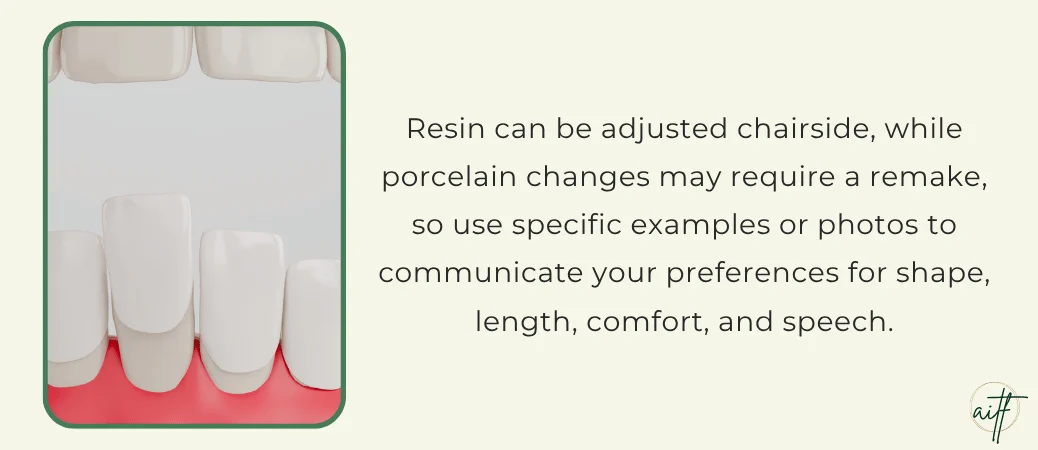
Shape and length edits are quick at this stage. Resin can be added or polished off while you sit in the chair. After porcelain is made, the same change can mean a remake.
Useful requests sound specific:
- “The front two look a little long when I talk.”
- “Can the corners be softer?”
- “I want the side teeth to show a bit more when I smile wide.”
- “This feels too bulky against my upper lip.”
- “I hear a whistle on my S sounds.”
Vague words like “more natural” or “whiter” mean different things to different people. Point at a photo or a specific tooth instead. If you like a look from a smile gallery, show the exact case.
What Should You Ask About Tooth Preparation and Alternatives?
The mock-up can show how much tooth needs to be shaped. If it sits over your teeth without looking bulky, the design is mostly additive, and preparation may be light in those spots.
Ask these questions in plain words:
- How much enamel will you remove from each tooth?
- Could composite bonding get me most of this result?
- Would straightening first reduce how much tooth is removed?
- What happens if I need to replace these in 10 or 15 years?
Sometimes the preview shows the real issue is tooth position. In that case, cosmetic dentistry without braces or a look at clear aligners vs braces may lead to a smile makeover with less tooth removal.
A thoughtful answer to these questions is also a good sign when choosing a cosmetic dentist for elective cosmetic dentistry.
Treat the Preview as Feedback, Not a Guarantee

A trial smile is a reliable guide to design and a weak guide to materials. Trust what you see and feel about shape, length, and how the smile fits your face.
Hold looser expectations about color, translucency, bite, and how long the result will last.
The most useful mindset is to treat the preview as a draft you get to edit. Speak up about every detail that bothers you, even small ones. Take photos in different light. Read aloud.
Keep three separate decisions in mind:
- Design: shape, length, and proportion, which the trial shows well.
- Shade: chosen with porcelain samples, apart from the mock-up.
- Candidacy: decided by an exam, X-rays, and a bite check.
If you are new to the process, knowing what to expect at a first visit can make that first planning conversation easier.
Frequently Asked Questions
Will my porcelain veneers look exactly like my trial smile?
The shape and length should be close, but the look will differ. Porcelain has more depth, translucency, and surface texture than the resin used in a preview, and finished veneers sit slightly thinner.
Expect the final result to look more lifelike than the trial.
Can a trial smile show whether veneers will affect my speech?
Yes, it gives a useful first test. Reading aloud and saying S, F, and V sounds shows whether the new edges change how you talk.
A short chairside trial cannot show how fast you will adjust, so longer-wear temporaries give a fuller picture.
Can I try a smile before any enamel is removed?
Yes, a standard mock-up is placed over your natural teeth and removed afterward. Some longer-wear versions use bonding steps, and temporary veneers come after preparation. Ask your dentist which type you are getting.
Can a trial smile tell me if I am a good candidate for veneers?
No, it only shows the design. Candidacy depends on healthy gums, no active decay, enough enamel, and a stable bite. Your dentist decides that through an exam and X-rays.
What if I like the trial smile but not its color?
That is common and easy to address. Mock-up resin is chosen for handling, so its shade does not reflect the final porcelain. Pick your color separately, and if you have questions about planning yours, ask your dental team to talk through shade options.