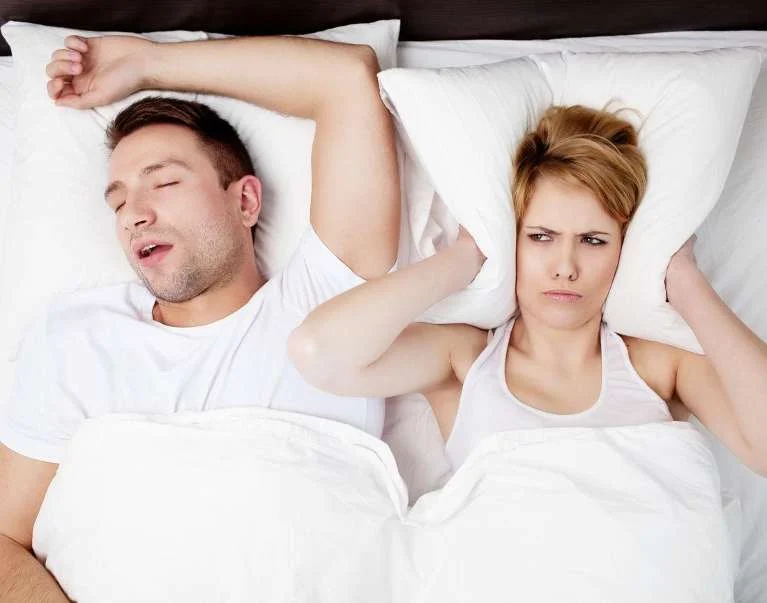
If your snoring has gotten louder or more frequent since you turned 50, you’re noticing something real.
Understanding sleep apnea risk after 50 becomes especially important when snoring gets louder, happens more nights than not, or starts disrupting your partner’s sleep.
Age-related snoring has clear physical causes, and most of them are worth understanding rather than ignoring.
Loud snoring on its own doesn’t mean something serious is wrong.
But when it shows up alongside daytime fatigue or restless nights, it’s worth a closer look, since it can be a sign that sleep quality has quietly dropped even when total hours in bed haven’t changed.
Older adults often chalk this up to “just getting older,” but the airway changes behind it are specific and, in many cases, manageable.
The volume and pattern of your snoring, not just the fact that it happens, is what tells you whether this is a normal part of aging or something that deserves a medical look.
This piece walks through what’s actually happening in your throat, how weight and hormones shift the picture after 50, and what steps make the biggest difference.
Key Takeaways
- Snoring often gets louder after 50 because of natural changes in throat muscle tone, tissue elasticity, and weight distribution around the neck.
- Menopause, alcohol, certain medications, and sleeping on your back can all make snoring worse, sometimes without any change on the scale.
- Loud snoring paired with daytime fatigue or breathing pauses is worth mentioning to a healthcare provider, since it can point to obstructive sleep apnea.
Why the Airway Becomes More Vulnerable With Age
Your airway gets less stable with age because the muscles and tissues holding it open lose strength and springiness over time.
The same process that softens skin and weakens grip strength also affects the throat, and the throat happens to be the one place where “softer” directly means “louder.”
How Snoring Starts in the Upper Airway
Snoring starts when air has to squeeze through a narrowed upper airway, causing soft tissue to vibrate. The usual culprits are the soft palate, the uvula, the tongue base, and the pharyngeal walls (the sides of your throat).
When these structures are firm and well-toned, air moves through quietly. When they’re loose, they flutter like a flag in the wind every time you breathe.
Loss of Muscle Tone and Slower Airway Responses
Throat muscles, including the genioglossus (the main muscle that keeps your tongue from falling back into your airway), lose tone as part of general age-related muscle decline.
This is connected to sarcopenia, the gradual loss of skeletal muscle mass that affects the whole body after midlife, not just your arms and legs.
Reduced pharyngeal muscle tone means your airway muscles respond more slowly when your breathing narrows, which is part of why snoring gets worse with age even in people who haven’t gained weight.
Collagen Loss, Tissue Elasticity, and a Floppier Soft Palate
Collagen production drops with age, and that affects tissue elasticity throughout your throat.
A soft palate with less collagen behaves like an old rubber band: it stretches out and doesn’t snap back the way it used to.
This “floppier” tissue is more likely to sag into the airway during sleep, raising the odds of airway collapse and making snoring louder and more frequent.
How Weight, Hormones, and Habits Can Narrow the Throat
Your airway can narrow even when your weight on the scale hasn’t budged, because where fat sits and what’s circulating in your bloodstream both matter as much as total pounds.
Weight gain, menopause, and certain daily habits each play a distinct role, and it helps to know which one applies to you.
Why Weight Distribution and Neck Size Matter More Than the Scale
Weight distribution around your neck affects your airway more than your overall weight does. Fat that collects behind the throat, known as parapharyngeal fat, presses inward on the airway regardless of what the scale says.
This is why neck circumference is often a better predictor of snoring risk than body weight; a heavier neck means less room for air to pass through.
Weight management and regular physical activity help, but tracking neck size gives you information the scale can’t.
Why Menopause Can Trigger New Snoring
Menopause can cause new snoring even in women who haven’t gained weight.
Falling oestrogen and progesterone levels affect muscle tone throughout the body, including the airway muscles, which is a major reason post-menopausal women snore more than they did before menopause.
Testosterone decline plays a smaller supporting role.
Hormonal changes around menopause are one of the most overlooked snoring triggers, and understanding sleep apnea risk after 50 is especially important for women experiencing new or worsening snoring.
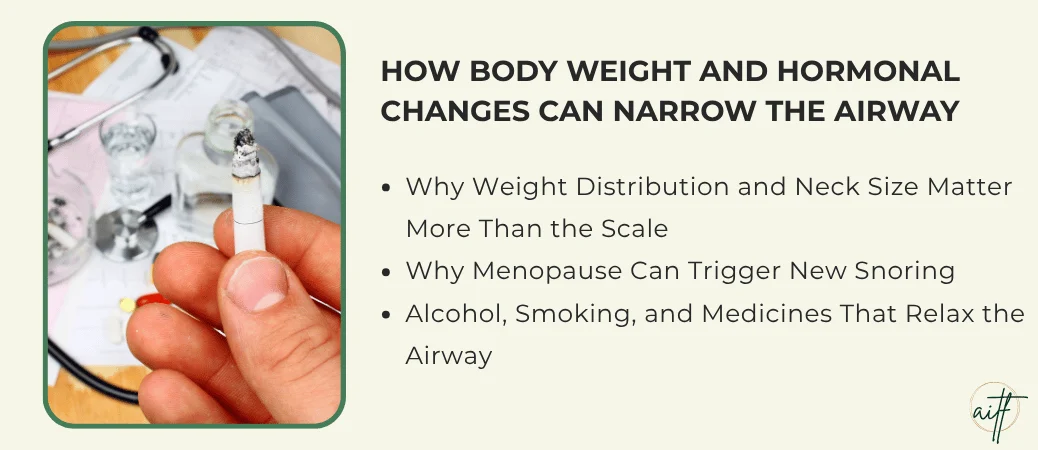
Alcohol, Smoking, and Medicines That Relax the Airway
Alcohol, smoking, and several common medications relax throat muscles enough to make snoring worse. A nightcap before bed loosens the same muscles that are supposed to keep your airway open.
Sedatives, benzodiazepines, muscle relaxants, some blood pressure medications, and antihistamines can have a similar effect.
If you’ve started a new prescription around the same time your snoring got louder, that timing is worth mentioning to your doctor.
When Louder Snoring May Be Obstructive Sleep Apnea
Louder, more frequent snoring can be a sign of obstructive sleep apnea (OSA), a condition where the airway repeatedly narrows or closes during sleep.
OSA falls under the broader category of sleep-disordered breathing, and it becomes more common with age for the same reasons ordinary snoring does: less muscle tone, less tissue elasticity, and more tissue in the way.
Warning Signs That Need a Sleep Evaluation
Pauses in breathing, gasping awake, and heavy daytime sleepiness despite a full night in bed are signs that go beyond ordinary snoring.
A partner noticing you stop breathing for several seconds at a time is one of the clearest signals. Morning headaches and trouble concentrating during the day round out the common warning list.
If any of these sound familiar, it’s worth learning to tell sleep apnea and snoring apart before assuming it’s just noise.
Why Untreated OSA Affects More Than Energy Levels
Untreated OSA disrupts sleep architecture, cutting into the slow-wave sleep your body needs for real rest and repair.
Left unaddressed, it raises the risk of hypertension, stroke, and type 2 diabetes, according to the Ochsner Journal’s research on OSA prevalence.
These risks build gradually, which is part of why loud snoring deserves attention even when it doesn’t feel urgent.
A closer look at the hidden dangers of untreated sleep apnea lays out how these health effects connect back to a single unstable airway.
What a Sleep Study Can Clarify
A sleep study is the only way to confirm whether snoring has crossed into OSA territory. It measures how often your breathing pauses each hour and how those pauses affect your oxygen levels and sleep stages.
What Can Help Reduce Snoring After 50
Sleep position, nasal care, and, when appropriate, dental or medical devices can meaningfully cut down on snoring after 50.
Some of these changes take a single night to test; others need a professional’s input to get right.
Why Side Sleeping Often Works Better Than Back Sleeping
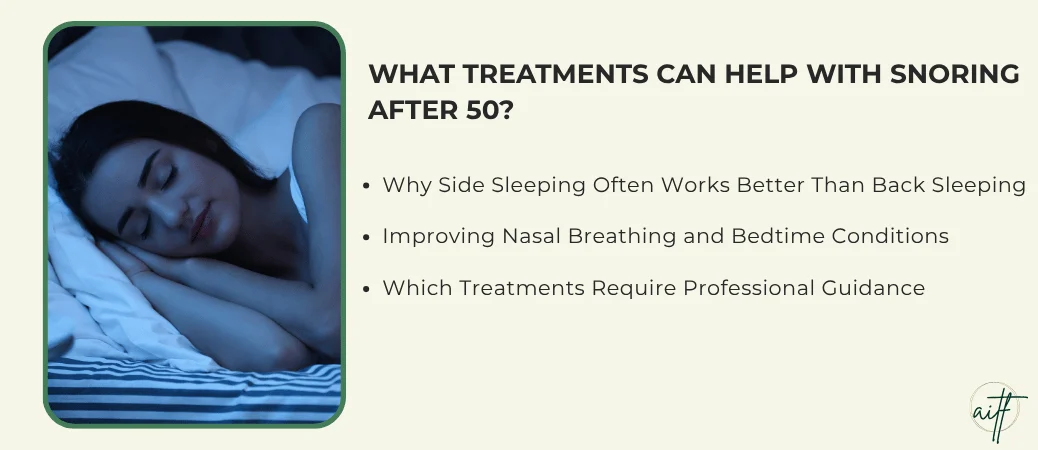
Side sleeping keeps your tongue and soft palate from falling backward into your airway the way back sleeping does.
This simple switch, known as positional therapy, is one of the easiest changes to make and often shows results the same night.
A body pillow or wedge pillow can help you stay on your side through the night, since most people who “try” side sleeping roll onto their back within an hour without one.
Improving Nasal Breathing and Bedtime Conditions
Clearer nasal breathing takes pressure off your throat by letting air in through the nose instead of forcing mouth breathing.
Treating nasal congestion or allergies, running a humidifier in dry rooms, and trying nasal strips are all low-risk starting points.
Oropharyngeal exercises (simple tongue and throat exercises done while awake) can also build back some of the muscle tone that age has worn down.
Which Treatments Require Professional Guidance
CPAP therapy and mandibular advancement devices need a diagnosis and professional fitting to work safely and effectively.
CPAP (continuous positive airway pressure) uses a bedside machine to keep the airway open all night and remains the standard treatment once OSA is confirmed.
A mandibular advancement device (MAD) works differently, gently repositioning the lower jaw forward to hold the airway open, and can be a good fit for people with mild to moderate OSA or primary snoring who haven’t tolerated a CPAP machine.
All In The Family Dental fits and adjusts these devices as part of oral appliance therapy, always working alongside a physician’s diagnosis rather than in place of one.
Surgical intervention is reserved for specific structural cases and is typically discussed only after other options have been tried.
A Quieter Night Starts With the Right Next Step

Snoring after 50 usually traces back to a mix of aging tissue, weight distribution, hormones, and habits, and most of it responds well to targeted changes.
Side sleeping, nasal care, and cutting back on alcohol before bed are reasonable first steps for anyone whose snoring is loud but otherwise unaccompanied by daytime symptoms.
If your snoring comes with breathing pauses, gasping, or daytime fatigue, a conversation with a healthcare provider is the right next move, since only a sleep study can confirm or rule out obstructive sleep apnea.
Physicians and sleep specialists help patients figure out where dental options like mandibular advancement devices fit into that care plan, and to make sure nothing gets treated with a device when CPAP is the medically indicated choice.
Weight management, better sleep habits, and the right professional support work best as a team, not as substitutes for each other.
Frequently Asked Questions
Is snoring after 50 normal, or is it a sign of sleep apnea?
Some increase in snoring after 50 is common, since throat muscle tone and tissue elasticity naturally decline with age.
Loud, frequent snoring paired with breathing pauses, gasping, or daytime fatigue is different and worth a sleep evaluation, since those symptoms point toward possible sleep apnea rather than ordinary age-related snoring.
What type of snoring is dangerous?
Snoring that includes pauses in breathing, choking or gasping sounds, or is followed by loud snorts as breathing restarts is the type that needs attention.
This pattern, especially alongside daytime sleepiness or morning headaches, suggests obstructive sleep apnea rather than simple snoring.
Can menopause cause snoring even without weight gain?
Yes, menopause can cause new snoring on its own. Falling oestrogen and progesterone levels reduce muscle tone in the airway, which can lead to louder or new snoring in post-menopausal women even when their weight hasn’t changed.
Does sleeping on your side help with sleep apnea and snoring?
Side sleeping helps many people with mild snoring and mild positional sleep apnea, since it keeps the tongue and soft palate from collapsing backward.
It works best as one part of a broader plan and doesn’t replace a sleep study or CPAP therapy for moderate to severe sleep apnea.
Can a mandibular advancement device replace CPAP therapy?
A mandibular advancement device is not a direct substitute for CPAP when CPAP is medically indicated, though it can be an effective option for primary snoring or mild to moderate obstructive sleep apnea.
Can sleep apnea be reversed naturally?
Mild sleep apnea sometimes improves with weight loss, side sleeping, and cutting out alcohol or sedatives before bed.
Moderate to severe sleep apnea usually needs CPAP therapy or a dental device alongside these habit changes, since lifestyle steps alone rarely resolve significant airway collapse.