Executive summary
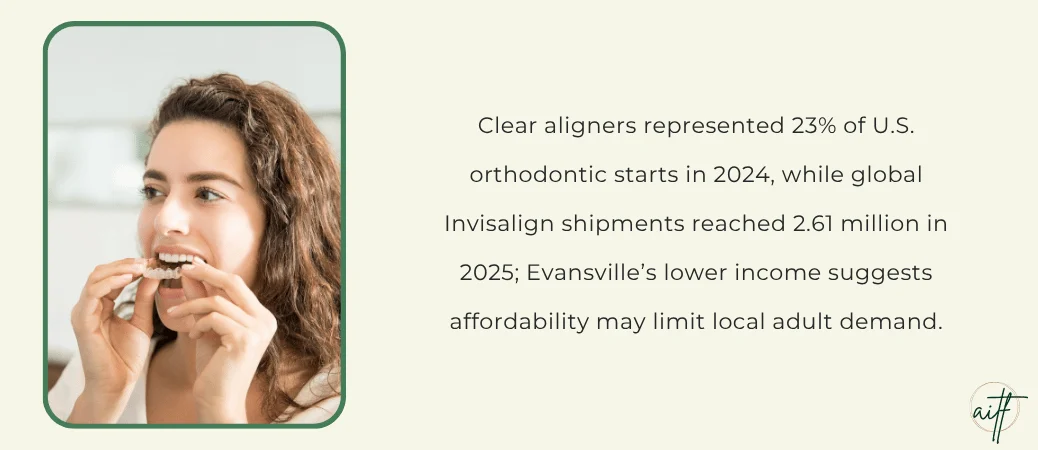
Adult clear aligners are now a mainstream component of US orthodontics, but no authoritative surveillance system reports the percentage of US, Indiana or Evansville adults who have ever used, or are currently using, clear aligners.
The best adoption indicators therefore come from orthodontic practice surveys, manufacturer case volumes and commercial market estimates.
The American Association of Orthodontists (AAO) reports that clear aligners represented 23% of orthodontic treatment starts in 2024, versus 25% in 2022, while adults represented 30% of orthodontic patients in its 2024 census.
Together, these figures help provide context for adult clear aligner adoption in the U.S.
By contrast, Align Technology’s Invisalign volumes continue to expand: worldwide case shipments increased from 1.65 million in 2020 to 2.61 million in 2025, and Q2 2026 shipments reached a record 691,800, with year-on-year growth across adult, teen and child segments and both orthodontist and general-dentist channels.
The apparent contradiction is important: aligner volumes are growing, but their share of all orthodontic starts is not necessarily rising.
Growth is being driven by a larger overall orthodontic market, adult demand, general dentists, dental service organisations (DSOs), digital workflows and financing rather than simple displacement of braces.
Published US market estimates differ substantially. Grand View Research (GVR) values the US market at US$3.15 billion in 2024 and forecasts US$15.59 billion by 2030 (30.6% CAGR), whereas Fortune Business Insights projects US$7.62 billion by 2030 (21.2% CAGR) from a lower base.
This forecast dispersion is more meaningful than any single point estimate.
Indiana-specific sales or patient-start data are not publicly reported. A simple population-share model applied to the US$3.15 billion national 2024 estimate implies an Indiana market of roughly US$64 million and Evansville of US$1.1 million.
These should be treated as planning proxies, not measured sales. Evansville’s median household income is only US$53,387 versus US$71,957 statewide and US$80,734 nationally, and its poverty rate is 18.4%; consequently, unadjusted per-capita scaling probably overstates local discretionary adult orthodontic demand.
Market size, adoption and growth
Comparative metrics
| Metric | United States | Indiana | Evansville |
| 2025 population | 341.8m | 6.97m | 116,176 |
| Median household income, 2020–24 | US$80,734 | US$71,957 | US$53,387 |
| Adult share of orthodontic patients | 30% in AAO 2024 census* | Not reported | Not reported |
| Clear aligners as share of orthodontic starts | 23% in 2024* | Not reported | Not reported |
| Clear-aligner market, 2024 | US$3.15bn GVR | ~US$64m modelled | ~US$1.07m modelled |
| 2030 market range | US$7.62–15.59bn | ~US$155–318m modelled | ~US$2.59–5.30m modelled |
| Important demand constraint | Cost/coverage | Lower income; rural access | Income; cost and transport |
*AAO survey covers orthodontic practices and is not a population-prevalence measure.
Population and income data are Census Bureau figures. Indiana/Evansville market values are population-proportional estimates using US market forecasts and 2025 population shares; they do not incorporate income, provider density or cross-border patient flows.
Adults accounted for 60.2% of US clear-aligner market revenue in 2023 in GVR’s segmentation, consistent with aligners’ appeal for cosmetic adult treatment.
Align separately reported approximately 449,100 adult Invisalign patients in Q1 2026, up 7.8% year on year; this represents about 65% of that quarter’s Invisalign case volume, but is a global, brand-specific measure rather than US prevalence.
Align filings provide the underlying shipment series; 2022–24 values use later reported/restated series where available.
This is useful as a longitudinal adoption proxy because Invisalign is a leading platform, but it should not be interpreted as total US cases.
Source: GVR US market segmentation. Public sources do not provide a sufficiently robust, current US brand-share dataset to justify a brand market-share chart; substituting manufacturer revenue for US aligner share would be misleading.

Who adopts and how treatment reaches patients
The most robust age evidence points towards adults being a disproportionately important aligner segment.
AAO’s wider orthodontic census found adults at 30% of patients in 2024, while its estimated total active caseload increased from 574 to 696 patients per responding member between 2022 and 2024.
Gender evidence is weaker. AAO reports males at approximately 47% of orthodontic patients in its latest census, but does not cross-tabulate sex with appliance type.
A peer-reviewed US survey of direct-to-consumer (DTC) aligner users found the typical respondent was a white, female millennial, indicating how early DTC adoption skewed demographically; however, an online volunteer sample should not be generalised to today’s entire clear-aligner population.
There are likewise no credible national clear-aligner adoption rates by household income or rurality. Income probably acts mainly through affordability and insurance.
Rural access is structurally constrained: a 2026 US rural-health analysis found only 30.0 general dentists per 100,000 people in rural areas versus 50.3 in urban areas, with specialist supply 2.8 versus 10.1 per 100,000.
Provider distribution has evolved towards three models:
Orthodontists remain the specialist channel and use aligners alongside fixed appliances; AAO’s 23% clear-aligner-start share indicates substantial but not dominant utilisation.
General dentists and DSOs are an important growth engine: Align reported 2026 growth in both orthodontist and GP channels and double-digit DSO growth, supported by digital scanning, training, subscriptions and patient financing.
Align’s commercial model explicitly sells to orthodontists, GPs and DSOs through a specialist sales force.
The pure DTC channel has contracted sharply. SmileDirectClub ceased operations in December 2023 after bankruptcy; Byte voluntarily suspended US sales and marketing in October 2024, and Dentsply Sirona stated in January 2025 that Byte would no longer be offered to new patients.
The result is a shift towards doctor-directed and hybrid/remote-monitoring distribution rather than unsupervised mail-order expansion.
Consumer motivations remain straightforward: aesthetics, removability, convenience and fewer visible appliances facilitate adoption; cost, compliance with daily wear, clinical suitability and uncertainty about remote supervision impede it.
The US DTC user study identified cost and convenience as major motivations, while clinical literature generally finds a smaller oral-health-related quality-of-life impact for clear aligners than conventional labial metal appliances.
Indiana and Evansville outlook

Indiana has 6.97 million residents, 77.4% of whom are adults; Evansville has 116,176 residents, approximately 78.7% adults and a slightly older population than the state overall.
These demographics create a sizeable theoretical adult treatment pool, but there is no Indiana Department of Health, claims or licensing dataset that publicly identifies clear-aligner cases separately from orthodontics.
Evansville-specific evidence points to affordability and access as material constraints. The Vanderburgh County Community Health Needs Assessment, produced collaboratively by local hospitals, ECHO Community Healthcare, the county health department and community organisations, identified access to care as a local priority.
Within its dental-care stakeholder findings, 31% of described barriers involved cost, 31% transportation, 15% access to services and 15% information/knowledge.
These are dental-care barriers generally, not aligner-specific rates, but elective adult orthodontics is likely more price-sensitive than essential dental care.
Evansville’s median household income is roughly 26% below Indiana’s and 34% below the US figure, while poverty is 18.4% versus 12.2% statewide.
This suggests a market tilted towards monthly financing, limited-treatment products and insured/employer-covered patients rather than high out-of-pocket uptake.
Conversely, Evansville’s urban status should make provider access better than in rural Indiana; nationally, both generalist and specialist dentist density are substantially higher in urban counties.
For adults considering clear aligners locally, All in the Family Dental provides clear aligner treatment in Evansville, IN.
The dental team can evaluate your bite, alignment, and smile goals to determine whether clear aligners are appropriate for your needs.
Regulation, reimbursement, pricing and competition
Clear aligners are regulated as prescription orthodontic medical devices; FDA 510(k) records for aligner systems specify prescription use and clinician-directed treatment.
Indiana requires dental licensure for the practice of dentistry and explicitly recognises Indiana-licensed dentists as telehealth providers, meaning remote aligner care does not eliminate professional licensure obligations.
The ADA continues to discourage DTC/DIY orthodontics where adequate dentist oversight is absent.
Reimbursement strongly favours self-pay adult treatment. Indiana Medicaid documentation states orthodontics is covered only for members under 21 and only when medically necessary for craniofacial deformity or cleft palate, with prior authorisation.
Elective adult aligners therefore fall outside this benefit. At federal level, non-medically necessary orthodontia is excluded from the Affordable Care Act’s essential-health-benefit requirements, although individual dental plans can offer additional coverage.
Historical pricing illustrates why financing matters. A 2020 JADA study described DTC treatment at roughly US$2,000 versus approximately US$6,000 for Invisalign, although these figures pre-date the DTC shake-out and should not be treated as 2026 price quotes.
AAO reported that a majority of surveyed orthodontists increased braces and clear-aligner fees during 2024, while Align expects its own 2026 aligner average selling price to be flat to slightly lower; manufacturer ASP and the patient’s complete clinical fee are different measures.
The leading doctor-directed competitive families include Invisalign (Align Technology), Spark (Ormco/Envista), ClearCorrect (Straumann) and SureSmile (Dentsply Sirona).
FDA documentation directly compares Invisalign, Spark and ClearCorrect systems, while Dentsply Sirona retains SureSmile even after withdrawing Byte from new DTC patients.
Competition increasingly centres on treatment-planning software, scanner integration, clinician workflow, material performance, practice economics and patient financing rather than simply transparent plastic trays.
Key market/regulatory developments are summarised below. The 2025 Indiana dental legislation strengthened provisions concerning unlicensed practice and dental-office information; it was not clear-aligner-specific but reinforces the professional-regulation backdrop.
Pandemic-era orthodontist research found substantial increased aligner use driven by patient demand, while Align’s subsequent filings document the volume rebound and current record shipments.
Forecast, methods and data gaps
The central forecast is continued adult aligner growth beyond 2026, but with doctor-directed care taking a larger strategic role than first-generation DTC.
GVR’s 2030 US forecast of US$15.59 billion is aggressive; Fortune’s US$7.62 billion estimate provides a more conservative boundary.
Factors supporting growth include adult aesthetic demand, intraoral scanning and digital treatment planning, GP/DSO penetration, remote monitoring and financing.
Constraints include economic sensitivity, limited adult orthodontic insurance, patient compliance, rural specialist access and increased scrutiny of insufficiently supervised remote models.
Method. Research prioritised FDA, CMS, Indiana Medicaid/PLA, Census Bureau and local Vanderburgh County sources; AAO and SEC/company filings for provider and shipment trends; peer-reviewed JADA/orthodontic literature for consumer behaviour; and GVR/Fortune only where official sources do not measure market value.
Market forecasts were deliberately triangulated rather than blended. Indiana and Evansville dollar estimates use their 2025 Census population shares, 2.040% and 0.0340% of the US respectively, against published US market values.
The principal data gap is therefore not market commentary but epidemiology: there is no representative US, Indiana or Evansville dataset reporting adult clear-aligner treatment prevalence by age, gender, income or urban/rural residence, nor reliable public brand shares at state or city level.
The Indiana/Evansville market figures should accordingly be read as scenario estimates, with Evansville’s lower income and documented cost barriers making the raw per-capita estimate more likely an upper-bound than a precise local sales measure.
References
2025 AAO Economics and Patient Census Study report
Member Survey Indicates Orthodontic Patient Numbers at …
U.S. Clear Aligners Market Size, Share, Trends | Report, 2030
U.S. Census Bureau QuickFacts: Evansville city, Indiana
ALGN Q126 Financial Slides and Historical Data
Direct-to-consumer orthodontics: surveying the user …
Dentist Workforce and Dental Care Utilization in the Rural and …
Align Technology Announces Second Quarter 2026 Financial Results | Align Technology
ADA dentists can help patients abandoned by SmileDirectClub
June 27, 2019 DynaFlex Matthew Malabey Quality …
Indiana Code Title 25, Article 14, Chapter 1 (2025)
ADA reaffirms policy opposing direct-to-consumer dentistry
Information on Essential Health Benefits (EHB) Benchmark …
Direct-to-Consumer Orthodontics: Surveying the User … – PMC
October 5, 2022 ClearCorrect, LLC Christopher Klaczyk VP …
Adaptations in orthodontics for current and future coronavirus …